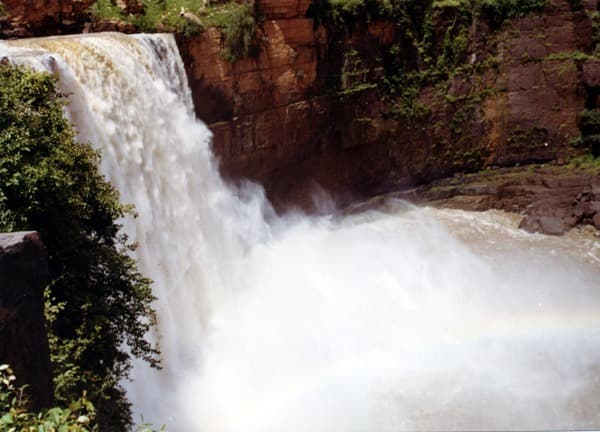
Gokak Falls is one of the most majestic waterfalls in the Deccan Plateau. Formed by the Ghataprabha River as it plunges 52 metres over a horseshoe-shaped sandstone cliff, the falls stretch 177 metres wide at the crest, earning comparisons to the Niagara Falls and the proud nickname, the Niagara of Karnataka. Located 6.5 km from Gokak town in Belagavi district, this Gokak waterfall is far more than a scenic spectacle.
Quick Facts
| River | Ghataprabha River (tributary of the Krishna River) |
|---|---|
| Height | 52 metres (171 feet) |
| Width at Crest | 177 metres (581 feet) |
| Shape | Horseshoe / U-shaped |
| Location | Gokak, Belagavi District, Karnataka |
| Distance from Gokak Town | 6.5 km |
| Distance from Belagavi | Approx. 62 km |
| Distance from Bengaluru | Approx. 500–522 km |
| Entry Fee | No entry fee (nominal parking charges may apply) |
| Timings | Open during daylight hours; visitors advised to leave before sunset |
| Best Time to Visit | July to February (Monsoon & Post-monsoon ideal) |
| Nearest Railway Station | Ghataprabha / Gokak Road Railway Station (~7–8 km) |
| Nearest Airport | Belagavi Airport / Sambra Airport (~62–75 km) |
History & Heritage
Gokak Falls holds a distinguished place in India’s history, not merely as a natural wonder, but as the birthplace of the country’s hydroelectric power generation. When British administrators discovered the waterfall in the latter half of the 19th century, they recognised the enormous potential of its powerful flow. A hydroelectric station was established here in 1887, making Gokak Falls home to one of India’s earliest pioneer industrial hydroelectric power plants (established in 1887 to directly power the cotton mills).
(Note: Sidrapong in 1897 and Shivanasamudra in 1902 are historically recognized as the first grid-connected/municipal power stations). The electricity generated powered the neighbouring Gokak textile mill, which remains one of the oldest cotton mills in the country and still operates today, converting cotton into yarn.)
The area also has deep ancient roots. The name ‘Gokak’ is said to derive from the Goki trees once found abundantly in the region.
The Hanging Bridge
One of the most thrilling and visually iconic features about Gokak Falls is the hanging bridge, a century-old suspension structure originally built by the British to allow textile mill workers to cross the Ghataprabha River. Spanning approximately 200–210 metres in length and suspended 14 metres above the riverbed, the bridge sways gently as visitors walk across it, offering an exhilarating experience unlike any other.
Access to the bridge may be restricted during peak season or when crowd density is high, as the structure is an ageing heritage installation. Visitors are advised to check with the authorities on-site before heading to the bridge. Mornings on weekdays offer the best chance to cross it with fewer crowds and calmer conditions.
Note: Due to structural aging and safety regulations by local authorities, walking/crossing over the hanging bridge is restricted/closed to the public, though it remains a central heritage landmark and photo background.
Gokak Falls Viewpoint
Multiple vantage points around Gokak Falls offer distinct perspectives of the waterfall, each with its own character and photographic appeal.
Volkart Viewpoint (Front View)
Located near the old hydroelectric power station, this is considered the best spot for a frontal, unobstructed view of the falls. The Ghataprabha tumbles down from directly ahead, and the full width of the horseshoe-shaped crest is visible. This is the most photographed angle of Gokak Falls.
Hanging Bridge Viewpoint
Viewing the falls from the banks near the suspension bridge offers an elevated perspective of the gorge below. This viewpoint is uniquely immersive; the sound, the wind, and the proximity of the water make it a sensory experience.
Clifftop Viewpoint
Visitors who venture to the top of the sandstone cliff can peer down from the edge into the depths of the gorge where the water crashes below. This is a dramatic vantage point offering a bird’s-eye view, though visitors must exercise caution around the edges.
Temples at Gokak Falls
Gokak Falls is as much a spiritual destination as a natural one. On both banks of the rocky gorge stand temples of significant historical and religious importance, built in the classic Chalukyan architectural style that flourished in this region between the 6th and 12th centuries.
Mahalingeshwara Temple (Tarakeshwara Temple)
The Mahalingeshwara Temple is the most prominent temple near Gokak Falls. Built in the 11th century, this Shiva shrine features Later Kalyani Chalukyan architecture. It stands along the Ghataprabha riverfront, opposite the textile mill, and overlooks the gorge.
Intricate carvings adorn its tall shikhara (spire). The temple includes a large courtyard and a well-preserved sanctum sanctorum, making it an important heritage site. Locals also call it the Tarakeshwara Temple. Devotees visit all year round, and the temple sees large crowds during Mahashivaratri.
Goddess Durga Temple
Situated on the banks of the gorge, this temple is dedicated to the fierce and protective goddess Durga. Built in the Chalukyan tradition, it draws devotees seeking blessings, particularly during Navratri. The temple’s riverside location gives it a scenic and serene quality.
Lord Shanmukha Temple
Among the Chalukyan monuments on either side of the rocky gorge, the Lord Shanmukha Temple honors the six-faced war deity, a form of Murugan or Kartikeya. It forms a triad of worship sites along with the Durga and Mahalingeshwara temples.
Best Time to Visit
Gokak Falls undergoes a dramatic transformation across seasons. The right time to visit depends on what kind of experience you seek.
| Season | Rating | What to Expect |
| Monsoon (July–October) | ⭐⭐⭐⭐⭐ | Ghataprabha is at full flow, the falls thunder at maximum volume and breadth. Mist, rainbows, and lush greenery all around. Most dramatic and photogenic. Surfaces can be slippery; exercise caution. |
| Post-Monsoon (Nov–Jan) | ⭐⭐⭐⭐⭐ | Ideal balance of good water flow and comfortable weather. Skies are clearer, the gorge is green, and walking conditions are safer. Best season for families and first-time visitors. |
| Winter (Jan–Feb) | ⭐⭐⭐⭐ | Pleasant cool temperatures make sightseeing and temple visits very comfortable. Water levels begin to ease. A good season for leisurely exploration of the heritage sites. |
| Summer (Mar–June) | ⭐⭐ | Water levels are at their lowest, and temperatures can exceed 38°C. The falls lose much of their grandeur. Not recommended unless combining with other Belagavi itinerary stops. |
Things to Do
Walk the Hanging Bridge: Cross the 200-metre colonial-era suspension bridge for a thrilling aerial view of the falls.
Viewpoint Photography: Capture the falls from the Volkart viewpoint, the clifftop, or mid-bridge for stunning panoramic shots.
Temple Trail: Visit the Mahalingeshwara, Durga, and Shanmukha temples in the Chalukyan architectural style along the gorge.
Heritage Exploration: Tour the colonial-era textile mill and the historic hydroelectric power station- India’s first.
Clifftop Walk: Walk along the sandstone cliff edges for dramatic views into the gorge (take care near the edges).
Nature Hike at Yogi Kolla: A 3-km walk through rocky terrain and forest paths offers scenic views of the surrounding valley.
Snacks & Local Produce: Pick up roasted corn from local vendors near the bridge, or sample Gokak’s famous Karadant sweet (a nutritious traditional delicacy made from edible gum, organic jaggery, ghee, and fried dry fruits) from nearby shops.
Nearby Attractions
| Attraction | Distance | Why Visit |
| Godachinmalki Falls | ~13 km | A two-tiered waterfall on the Markandeya River set amid green farmland; a peaceful second stop on a nature trail. |
| Yogi Kolla | ~3 km | A scenic hiking spot with rocky terrain and forest paths; good viewpoints of the surrounding valley. |
| Saundatti Yellamma Temple | ~73 km | A major pilgrimage site dedicated to Goddess Renukadevi atop Yellamma Gudda; historically significant. |
| Belagavi Fort | ~62 km | A 13th-century fort with Jain temples and colonial barracks; a key heritage landmark in northern Karnataka. |
| Ghataprabha Bird Sanctuary | Within area | Located along the Ghataprabha River near Gokak, excellent for bird watching, especially migratory species. |
| Sogal Durga Temple | ~20 km | A hilltop temple with panoramic views; a popular Belagavi district pilgrimage stop. |
How to Reach Gokak Falls
By Air
The nearest airport is Belagavi Airport (Sambra Airport), approximately 62–75 km from Gokak town.
By Train
The nearest railway stations are Ghataprabha Railway Station and Gokak Road Railway Station, both approximately 7–8 km from the falls.
By Road
Gokak Falls is well-connected by road. From Gokak town, the falls are 6.5 km, accessible by auto-rickshaw, local bus, or taxi. For travellers driving from Bengaluru, the distance is approximately 500–522 km via NH48 or NH67, and the journey takes 7–8 hours.
Where to Stay
Accommodation options in Gokak town are modest but functional, with budget lodges and guesthouses available close to the town centre. For a wider range of hotels and better amenities, most visitors choose to stay in Belagavi (62 km away), which offers hotels across all price points, from budget homestays to mid-range business hotels. Belagavi is also well-positioned as a base for exploring Gokak Falls, Godachinmalki Falls, and Saundatti Yellamma Temple in a single day trip.
Conclusion
Gokak Falls is not just a waterfall; it is a complete destination. Whether you are a nature lover chasing monsoon spectacle, a history enthusiast drawn to colonial and Chalukyan heritage, a family planning a day trip from Belagavi, or a photographer looking for Karnataka’s most dramatic water vistas, Gokak Falls delivers on every count. Plan your trip to Gokak Falls and experience the Niagara of Karnataka for yourself.
FaQs
1. Which river flows through Gokak Falls?
Gokak Falls is formed by the Ghataprabha River, a major tributary of the Krishna River. After traversing a long course through the Deccan plateau, the Ghataprabha plunges 52 metres over a sandstone cliff to create the waterfall.
2. What is the entry fee for Gokak Falls?
There is no entry fee to visit Gokak Falls. However, a nominal parking charge may be applicable. Camera fees, if any, may be collected on-site. Always verify the latest charges with local authorities upon arrival.
3. What is the best time to visit Gokak Falls?
The best time to visit is from July to February. The monsoon months (July to October) offer the most dramatic view, with the falls at maximum flow. Post-monsoon (November to January) combines good water levels with comfortable temperatures, making it ideal for families and first-time visitors.
4. What is the hanging bridge at Gokak Falls?
The Gokak Falls hanging bridge is a century-old suspension bridge, approximately 200–210 metres long, built during the British era to allow textile mill workers to cross the Ghataprabha River. Suspended 14 metres above the riverbed, it offers a thrilling aerial view of the falls directly below and is one of the most iconic features of the site.
5. Is there a glass bridge at Gokak Falls?
As of the latest available information, there is no Gokak Falls glass bridge. The primary bridge attraction remains the historic hanging suspension bridge. Visitors should check with Karnataka Tourism or local authorities for any recent infrastructure developments.
6. How far is Gokak Falls from Bangalore?
Gokak Falls is approximately 500–522 km from Bengaluru (Bangalore) by road. The drive takes around 7–8 hours via NH48 or NH67. Alternatively, travellers can take a train to Belagavi and then proceed by road to Gokak, approximately 62 km further.
7. Why is Gokak Falls called the Niagara of India?
Gokak Falls earns this comparison due to its striking resemblance to North America’s Niagara Falls. It shares a similar horseshoe or U-shaped crest, a width of 177 metres, a dramatic plunge of 52 metres, and heavy water volume during the monsoon season.
8. What temples can be visited near Gokak Falls?
3 historically significant temples are located on either bank of the Gokak gorge: the Mahalingeshwara Temple (also called Tarakeshwara Temple), an 11th-century Shiva shrine built in the Kalyani Chalukyan style; the Goddess Durga Temple; and the Lord Shanmukha Temple.